The demo trap
Every AI agent project starts the same way. Someone builds a prototype. It calls an LLM, maybe chains a few tools together, and produces impressive results on a laptop. The demo lands. Budget gets approved. Then the real work begins.
This is where most projects stall.
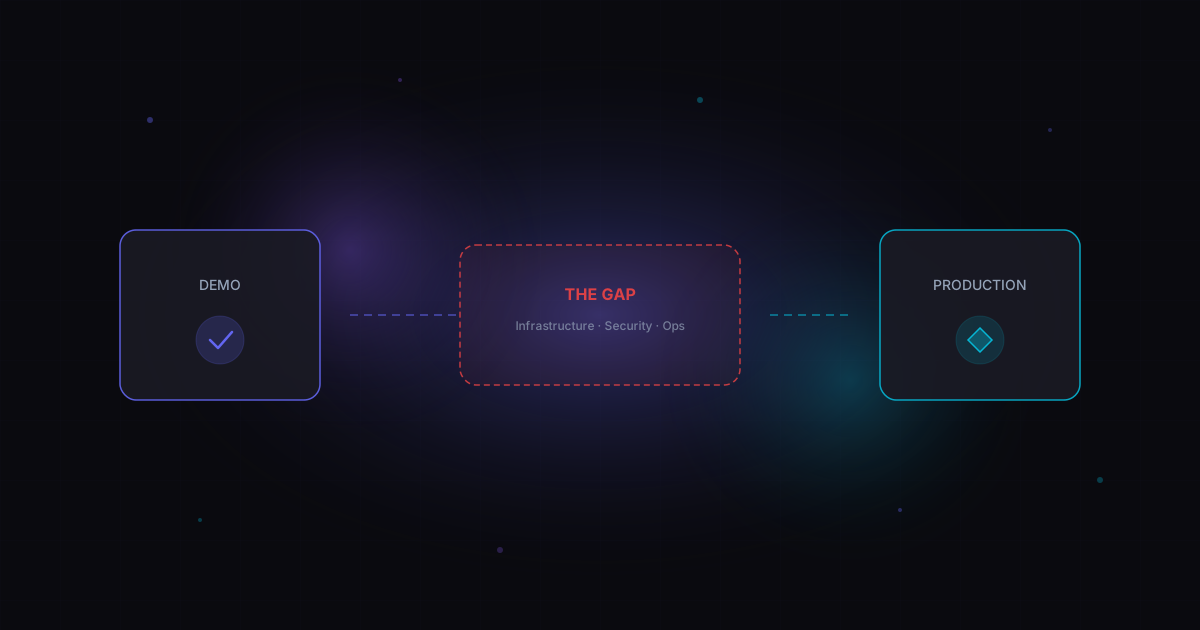
The gap between a working demo and a production deployment is not a small engineering task. It is a fundamentally different problem. The demo proves the AI works. Deployment proves your organisation can operate it.
Where things actually break
Infrastructure that does not exist yet
Your agent needs to run somewhere. Not on a laptop, not in a notebook, but in a container runtime with networking, secrets management, health checks, and auto-scaling. Most AI teams do not have this infrastructure ready. They are building models, not platform engineering.
The result is weeks spent on Kubernetes manifests, Dockerfiles, and CI/CD pipelines before the agent ever handles real traffic.
Security that was never designed for agents
Traditional web applications have well-understood security patterns. Agents are different. They make autonomous decisions, call external APIs, and access sensitive data. The security model needs to account for:
- Tool access control - which tools can the agent call, and under what conditions?
- Data boundaries - what can the agent read and write?
- Credential management - how do API keys and tokens flow to agent processes?
- Audit trails - who authorised what the agent did?
Most teams discover these requirements after the first security review, not before.
Observability that does not cover agent behaviour
Standard application monitoring tracks requests, errors, and latency. Agent observability needs to track decisions, tool calls, token usage, and reasoning chains. Without this, debugging a production agent is like debugging a black box.
When an agent produces a bad result in production, you need to answer: what did it see, what did it decide, and why? Standard logging does not give you this.
Multi-tenancy that was an afterthought
If your agent serves multiple customers, you need isolation. Not just data isolation, but execution isolation, rate limiting, and per-tenant configuration. This is table stakes for any SaaS product, but it is rarely built into agent prototypes.
The platform engineering gap
The common thread in all of these failures is the same: AI teams are not platform teams. They should not have to be.
Building a great AI agent requires deep expertise in prompting, tool design, evaluation, and domain modelling. Building the infrastructure to deploy that agent requires deep expertise in container orchestration, networking, security, and operations.
Expecting one team to excel at both is unrealistic. Expecting them to build both from scratch is how projects slip from "two weeks to production" to "six months and still in staging."
What production-ready actually means
A production-ready agent deployment needs, at minimum:
- Container runtime with health checks, resource limits, and auto-scaling
- Secrets management that does not involve environment variables in plain text
- Networking with proper ingress, TLS, and service mesh if needed
- Observability covering agent decisions, tool calls, and token usage
- Security with least-privilege access, audit logging, and credential rotation
- CI/CD that can deploy, roll back, and promote across environments
None of this is optional. All of it is infrastructure work that has nothing to do with building a better agent.
Closing the gap
The solution is not to make AI teams learn Kubernetes. It is to give them a platform that handles deployment, security, and operations so they can focus on what they are actually good at: building intelligent agents.
This is exactly the problem BiznezStack was built to solve. A deployment platform purpose-built for AI agents, so the path from demo to production is days, not months.
The demo is the easy part. Deployment is where the real work happens. The question is whether your team spends that time on infrastructure, or on making the agent better.