Beyond the protocol
The Model Context Protocol (MCP) has generated significant attention as a standard for how AI agents interact with external tools and data sources. But most of the discussion focuses on the protocol itself: the message format, the transport layer, the capability negotiation.
In production, the protocol is the least interesting part. What matters is what MCP servers enable in real-world agent deployments.
The integration problem
Every AI agent that does useful work needs to call external systems. A coding agent needs access to version control. A customer support agent needs access to ticketing systems. A data analysis agent needs access to databases and APIs.
Without a standard, every integration is bespoke. Each agent team writes custom code to authenticate with external APIs, handle errors, manage rate limits, and parse responses. This code is fragile, hard to test, and impossible to reuse across agents.
The result is that each new agent project reinvents the same integration layer, poorly.
What MCP servers actually provide
Standardised tool interfaces
An MCP server exposes a set of tools with well-defined inputs, outputs, and descriptions. The agent does not need to know how the underlying API works. It just needs to know what the tool does and what parameters it accepts.
This is a genuine productivity multiplier. Instead of writing and maintaining custom API clients for every external system, agent developers work with a consistent interface. The MCP server handles the underlying complexity.
Credential isolation
In a well-architected MCP deployment, the agent never sees raw credentials. The MCP server manages authentication with the external system, and the agent communicates with the MCP server through a controlled channel.
This is a significant security improvement over the common pattern of passing API keys directly to the agent process. If an agent is compromised or behaves unexpectedly, it cannot leak credentials it never had.
# Agent configuration - no raw credentials
mcp_servers:
  - name: github
    endpoint: mcp-gateway.internal:8443/github
    auth: oauth2  # handled by the gateway
  - name: jira
    endpoint: mcp-gateway.internal:8443/jira
    auth: oauth2
Capability boundaries
MCP servers can expose a subset of an external system's functionality. Your agent does not need full admin access to your GitHub organisation. It needs read access to specific repositories and the ability to create pull requests.
By controlling which tools an MCP server exposes, you create clear capability boundaries. The agent can only do what you have explicitly allowed. This is defence in depth for agent behaviour.
Observable tool calls
Every interaction between an agent and an MCP server is a structured message that can be logged, monitored, and audited. This gives you a complete record of:
- What tools the agent called
- What parameters it passed
- What responses it received
- How long each call took
This level of observability is essential for debugging, compliance, and understanding agent behaviour in production.
The scale problem
MCP servers become even more valuable at scale. Consider an organisation running 20 different agents, each needing access to some combination of GitHub, Slack, Jira, databases, and internal APIs.
Without MCP, that is potentially 100 bespoke integrations to build and maintain. With MCP, it is 5 server implementations that all 20 agents share. The integration surface area shrinks dramatically.
Shared infrastructure
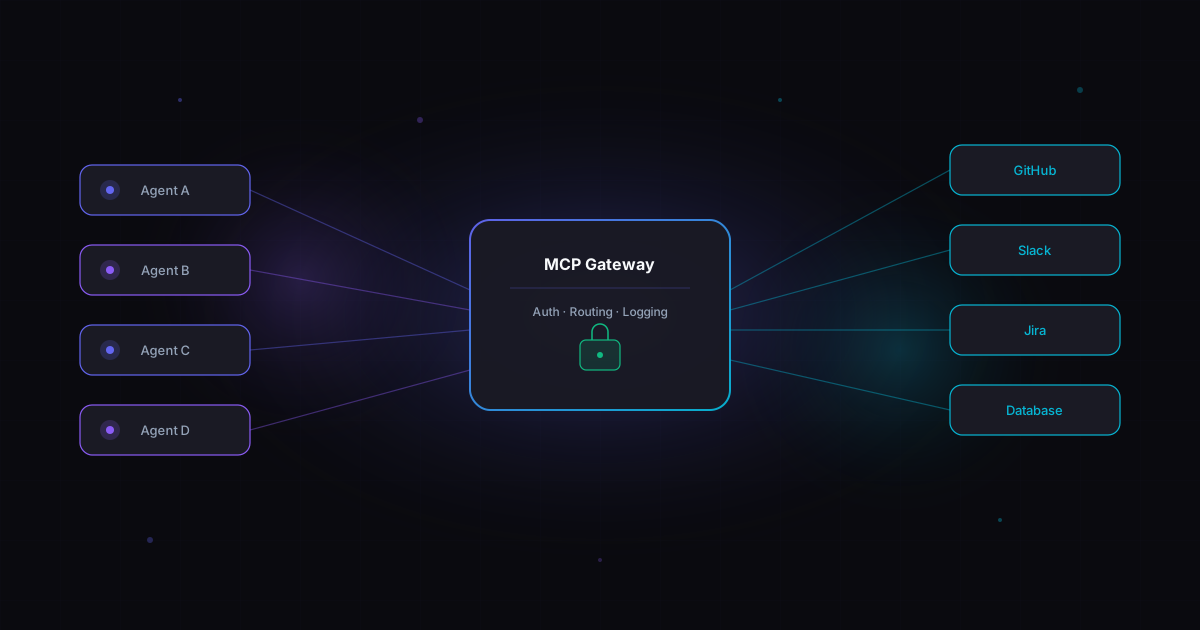
Agent A ──┐
Agent B ──┤── MCP Gateway ──┬── GitHub MCP Server
Agent C ──┤                 ├── Slack MCP Server
Agent D ──┘                 ├── Jira MCP Server
                            └── Database MCP Server
Each MCP server is maintained once. Updates, security patches, and new capabilities benefit every agent that uses it. This is the same principle that makes shared libraries and microservices valuable: centralise the complexity, distribute the benefit.
What MCP does not solve
MCP is not a silver bullet. It does not solve:
- Agent reasoning quality - a bad prompt with MCP is still a bad prompt
- Business logic - MCP handles tool access, not workflow orchestration
- Evaluation - you still need to test whether your agent makes good decisions
- Cost management - MCP does not optimise token usage or reduce API costs
MCP solves the integration and security layer. Everything above that is still your responsibility.
Production MCP architecture
For production deployments, we recommend an MCP gateway pattern:
- Agents connect to a central gateway, not directly to MCP servers
- The gateway handles authentication, routing, and rate limiting
- MCP servers run as isolated services, each managing one external integration
- All traffic is logged and auditable through the gateway
This architecture gives you a single control plane for all agent-to-tool communication. You can enforce policies, monitor usage, and rotate credentials without touching individual agents.
Getting started
BiznezStack provides a managed MCP gateway that connects your agents to 140+ pre-built MCP servers. No integration code to write, no servers to manage, no credentials to handle.
The MCP server catalog covers the most common enterprise integrations: version control, project management, communication tools, databases, cloud providers, and more. Each server is maintained, secured, and monitored as part of the platform.
The integration problem is solved. The question is whether you want to solve it yourself, or focus on building agents that deliver value.