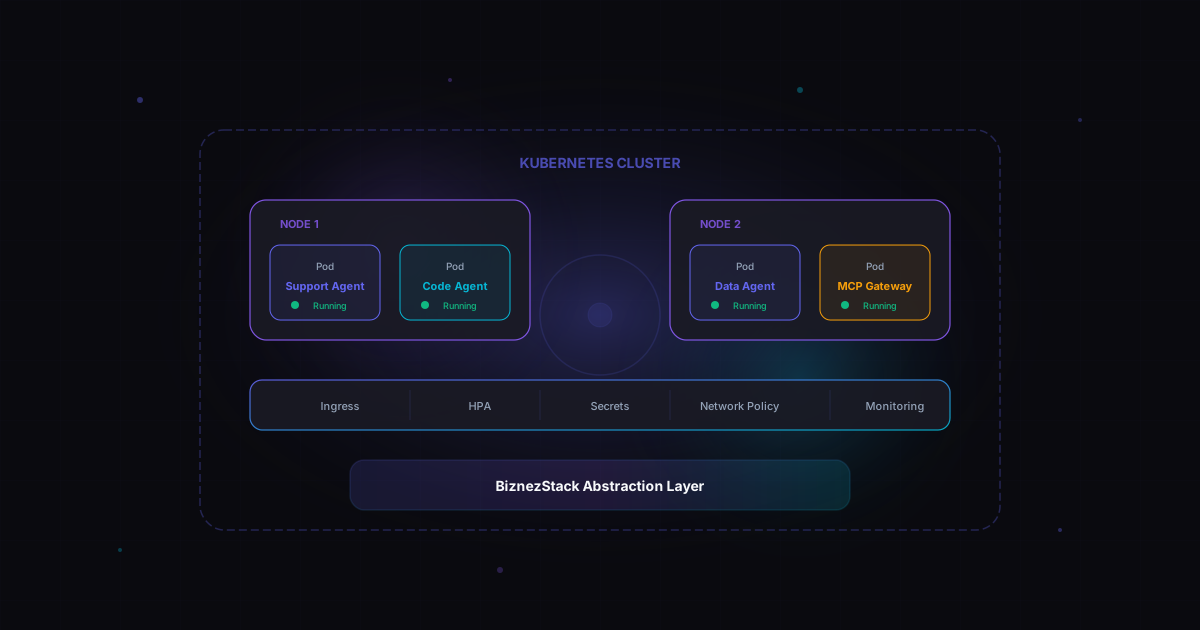
Kubernetes is the right answer, mostly
If you are running AI agents in production, Kubernetes is almost certainly the right infrastructure choice. It gives you container orchestration, auto-scaling, health checks, rolling deployments, and a massive ecosystem of tooling.
The problem is not Kubernetes itself. The problem is the operational complexity that comes with running agent workloads on it, especially when your team's expertise is in AI, not platform engineering.
What makes agent workloads different
Standard web services on Kubernetes follow well-understood patterns. A request comes in, gets processed, a response goes out. The resource profile is predictable. The scaling behaviour is well-defined.
Agent workloads break many of these assumptions.
Long-running and unpredictable
An agent processing a complex task might run for minutes, not milliseconds. It might make dozens of tool calls, each with variable latency. The resource profile is spiky and hard to predict.
Standard horizontal pod autoscaling based on CPU or memory often does not work well for agents. You need scaling based on queue depth, active tasks, or custom metrics.
High memory variance
An agent working with large context windows or processing documents can have significantly different memory requirements depending on the task. A 4K context request and a 128K context request on the same agent can differ by an order of magnitude in memory usage.
Setting resource limits too low causes OOM kills. Setting them too high wastes cluster resources. Finding the right balance requires understanding your specific workload patterns.
External dependency heavy
A typical web service might call a database and maybe one or two external APIs. An agent might call an LLM provider, multiple MCP servers, vector databases, and several external APIs in a single task.
Each of these dependencies needs:
- Connection management
- Timeout configuration
- Retry logic with backoff
- Circuit breaking for degraded services
The failure surface area is much larger than a traditional service.
The Kubernetes manifests nobody wants to write
Here is a simplified version of what a production agent deployment actually needs:
apiVersion: apps/v1
kind: Deployment
metadata:
  name: customer-support-agent
spec:
  replicas: 3
  strategy:
    rollingUpdate:
      maxSurge: 1
      maxUnavailable: 0
  template:
    spec:
      containers:
        - name: agent
          resources:
            requests:
              memory: "1Gi"
              cpu: "500m"
            limits:
              memory: "4Gi"
              cpu: "2000m"
          livenessProbe:
            httpGet:
              path: /healthz
              port: 8080
            initialDelaySeconds: 30
            periodSeconds: 10
          readinessProbe:
            httpGet:
              path: /readyz
              port: 8080
            initialDelaySeconds: 10
            periodSeconds: 5
          env:
            - name: LLM_API_KEY
              valueFrom:
                secretKeyRef:
                  name: agent-secrets
                  key: llm-api-key
And this is just the deployment. You also need:
- Service and Ingress for networking
- HPA or KEDA for autoscaling
- NetworkPolicy for traffic isolation
- ServiceAccount and RBAC for least-privilege access
- PodDisruptionBudget for availability during cluster maintenance
- ConfigMap for agent configuration
- Secret for credentials
- ServiceMonitor for Prometheus metrics
For a single agent, that is easily 8-10 Kubernetes manifests to write, test, and maintain. For 5 agents, it is 50. The YAML multiplication is real.
Common mistakes we see
Running agents as monoliths
Teams often deploy a single large agent process that handles everything. This makes scaling impossible: you cannot scale the document processing capability independently from the customer interaction capability.
Better approach: decompose agents by function and deploy them as separate services that communicate through well-defined interfaces.
Ignoring graceful shutdown
When Kubernetes needs to terminate a pod (during scaling down, updates, or node maintenance), it sends a SIGTERM and waits for a grace period. If your agent does not handle this signal, in-progress tasks get killed mid-execution.
For agents, graceful shutdown means:
- Stop accepting new tasks
- Finish current tasks (or checkpoint them)
- Clean up connections
- Exit cleanly
The default grace period of 30 seconds is often not enough for agent workloads. Set terminationGracePeriodSeconds to match your longest expected task duration.
No resource quotas per tenant
If you are running agents for multiple tenants on a shared cluster, resource quotas are essential. Without them, one tenant's workload spike can starve other tenants. Kubernetes namespaces with ResourceQuota and LimitRange objects give you this isolation.
Skipping network policies
By default, every pod in a Kubernetes cluster can talk to every other pod. For agent workloads that handle sensitive data, this is unacceptable. Network policies should restrict agent pods to only communicate with the services they actually need: the LLM provider, specific MCP servers, and their own data stores.
The abstraction layer you actually need
The solution is not to avoid Kubernetes. It is to put the right abstraction layer on top of it so that AI teams do not need to become Kubernetes experts.
A good agent deployment platform should:
- Accept a container image and a configuration - not a pile of YAML
- Handle scaling automatically - based on agent-specific metrics, not just CPU
- Manage secrets and credentials - with rotation and least-privilege access
- Provide observability out of the box - agent decisions, tool calls, token usage
- Enforce security defaults - network isolation, RBAC, audit logging
- Support multi-tenancy natively - resource quotas, data isolation, per-tenant config
This is what BiznezStack provides. Under the hood, it runs on Kubernetes. But AI teams interact with a purpose-built interface that speaks their language: agents, tools, configurations, and deployments. Not pods, services, and ingress controllers.
The right level of abstraction
Kubernetes gives you the primitives. A platform gives you the opinions. For AI agent deployment, the opinions matter more than the primitives.
You should not need to decide whether to use a Deployment or a StatefulSet for your agent. You should not need to write a custom HPA configuration for agent-specific scaling. You should not need to design a network policy that accounts for dynamic MCP server connections.
These are solved problems. They just need to be solved once, correctly, at the platform level.
The goal is simple: your AI team ships an agent, and it runs in production with enterprise-grade infrastructure. No YAML. No Kubernetes expertise required. No platform chaos.